Safety Tips

  • Holiday cooking tips

    The kitchen can be a busy place during the holiday season; prepping and preparing favorite recipes (or sampling those favorite recipes). With Covid-19, dining in restaurants has become less common, causing people to spend more time in their own homes and kitchens this season than ever before.

    However, whether you are a seasoned cook or novice baker, it’s important to keep electrical safety in mind. In the United States alone, approximately 1,000 deaths occur each year as a result of electrical injuries, according to the National Institutes of Health. An additional non-fatal 30,000 shock incidents occur each year. So, before you start getting your holiday casseroles ready, make sure safety is on your menu this year by using the following cooking tips:

    • Always read and follow an appliance’s operating instructions.
    • Always dry your hands before handling cords or plugs.
    • If an unplugged appliance cord gets wet or damp, do not plug it in until it is thoroughly dry.
    • Do not handle electrical cords or appliances when standing in water.
    • Pull on the plug, not the cord, to disconnect an appliance from an outlet.
    • To avoid damaging cords, don’t run them across walkways or underneath rugs. Draping them over walkways is also a tripping hazard.
    • Regularly inspect electrical cords and plugs for damaged insulation and exposed wiring; immediately discard any damaged item. Avoid using any cord or plug that is frayed, cracked, taped or otherwise questionable.
    • Do not overload extension cords, multi-pack power strips or surge protectors with too many appliances or other items or plug them into each other. Use them only as a temporary solution, and not a permanent one.
    • Ensure extension cords, power strips and surge protectors are in good condition and the appropriate gauge for the job (the lower the number, the bigger the gauge and the greater the amperage and wattage).
    • Never remove the third (round or U-shaped) prong from a plug, which is a grounding/safety feature designed to reduce the risk of shock
      and electrocution.
    • If you have doubts about your home’s electrical system, have a licensed electrician evaluate wiring, outlets, and switches to verify they are in working order.
    • Educate yourself and everyone in your household on how to properly turn off your home’s power in case of an emergency.


  • Electric shock drowning- what you need to know

    In the summer, the enjoyable activities of swimming and boating can quickly become dangerous. While water-safety behaviors such as wearing life jackets and maintaining safe boating speeds have become commonplace, a serious hazard remains that is often overlooked. This silent killer, known as electric shock drowning, occurs when an electric current escapes boats, docks, electric lines or lights, shocking and paralyzing nearby swimmers making them unable to swim to safety. There are no visible signs of electrical current seeping into water, and many electric shock drowning deaths are usually recorded as drowning because victims show no signs of burns, so many instances remain undocumented.

    But there are steps you can take to protect yourself and your loved ones from the hidden danger of electric shock drowning and common boat electrical hazards with these handy tips from Electrical Safety Foundation International.

    • Never allow anyone to swim near docks. Avoid entering the water when launching or loading a boat.
    • Always maintain a distance of at least 10 feet between your boat and nearby power lines. When fishing, make sure to cast the line away from power lines.
    • If you feel a tingle while swimming, the water may be electrified. Get out as soon as possible and avoid the use of metal objects such as ladders. Don’t ever go in the water to save someone who has been shocked because you could be shocked, as well. Turn off the power and then use a nonmetal object to pull the swimmer out of the water.
    • Have your boat’s electrical system inspected and upgraded by a certified marine electrician who is familiar with National Fire Protection Association (NFPA) codes 303 and NFPA 70.
    • Have Ground Fault Circuit Interrupters (GFCIs) – fast-acting circuit breakers designed to shut off power when they sense an imbalance – installed on your dock, boat and outlets for lighting around pools and spas and test them once a month.
    • Consider having Equipment Leakage Circuit Interrupters (ELCIs) installed on boats to protect nearby swimmers from potential electricity leakage into the water surrounding your boat.
    • Only use shore or marine power cords, plugs, receptacles and extension cords that have been tested by Underwriters Laboratories (UL), Canadian Standards Association (CSA) or Intertek (ETL).
    • Never use cords that are frayed or damaged or that have had the prongs removed or altered.
    • Never stand or swim in water when turning off electrical devices or switches.
    • Build pools and decks at least five feet from all underground electric lines and at least 25 feet away from overhead electric lines.
    • Do not put electric appliances within 10 feet of a swimming pool and use battery-operated appliances near pools if possible.
    • When you get out of the water, don’t touch any electrical appliances until you are completely dry.
  • Protect your pet from electrical hazards

    For many, pets are like members of the family, providing an indescribable companionship for owners. Two-thirds (67 percent) of U.S. households, or about 85 million families, own at least one pet, according to the 2019-2020 National Pet Owners Survey, conducted by the American Pet Products Association. Regardless of how large or small a pet may be, there are always potential electrical hazards around the corner.

    Here are a few safety tips to help you protect your pets from electrical hazards throughout the house:

    • Discourage pets from sleeping near or behind electronics. Many pets are attracted to the warmth, but this is a potential fire hazard.
    • Make sure plugs are completely plugged into an outlet. If not plugged in correctly, curious pets can get shocked.
    • Cover cords with cable jackets or PVC pipe in order to prevent pets from playing with or chewing on cords. Wind up excess cords and hide from view.
    • Coat cords with a bitter substance to make them undesirable to pets. Appropriate and safe products can be purchased online or at pet stores.
    • Unplug all appliances not in use to cut electric current.
    • Continuously check cords for fraying or bite marks.
    • Place cords out of pet’s reach, whether hanging off the floor or behind furniture.
    • Provide your pet with new and different chew toys so electrical cords do not become a dangerous replacement.
    • Make sure cords attached to an aquarium have a drip loop—cords that slack below the outlet—to make sure water does not run into the outlet.
    • Watch your pet around dangling or sagging cords, including phone or tablet charging cables. Unplug charging cables once your devices are charged. Not only do they draw a small amount of energy when not in use, but the dangling cords are just crying to be played with.
    • Don’t skimp when buying power cords, extension cords or anything else that you use for your electronics. Cheaper quality cords are much more likely to create sparks or overheat.
    • Be careful where you place lamps and other plugged-in items. Lamps can be a fire hazard if they are knocked over, especially if they have halogen bulbs.
    • Do not leave your pet alone around items that get hot: curling irons and straighteners, an outdoor grill, a portable heater and other electric appliances, including cooktops.
    • If a pet should receive a shock, never touch the animal until you know it is away from the power source or the electric current is shut off in order to prevent injury to yourself. Once it is clear to approach the pet, give it medical treatment immediately.

    Taking the time to make sure your home is safe for your pet will help ensure your friend will be around to bring happiness into your life for years to come.

  • Electrical safety in the workplace

    Electrical safety should be treated as a priority in every workplace. Electricity is a powerful force which can seriously injure and in the worst cases, be fatal. Here are some common electrical hazards in the workplace and safety tips that can help avoid accidents:

    • Be vigilant about power line locations if you are doing work outdoors, operating machinery, driving a truck that has hydraulic beds or lifts (dump truck), or arms/extensions (garbage truck, concrete truck), to name a few, and always use a spotter. Contact with a power line can kill! If your truck, tractor or equipment does come in contact with a line while you are inside it, DO NOT get out. Call 9-1-1 and wait for the power to be de-energized so you can safely exit.

    • Working with portable power tools presents inherent electrical risks. Defective tools, improper connections or misuse of tools greatly increases a worker’s chance of electrical injury. Never carry a tool by the cord or yank the cord to disconnect it from the receptacle. Keep cords away from heat, oil and sharp edges and disconnect them when not in use. Use gloves and appropriate safety footwear when using electric tools. Store electric tools in a dry place when not in use and do not use them in damp or wet locations unless they’re approved for that purpose.

    • Office workers can also be exposed to electrical hazards. Ungrounded equipment, overloaded circuits, defective or damaged power or extension cords, poor placement of extension cords, space heaters and   exposed live parts are just a few hazards that can be found in the workplace.

    • Be careful when working around water. Water and electricity don’t mix and it greatly increases the chance of shock. Keep all electrical equipment away from standing water or damp conditions (indoors or outdoors) and do not operate equipment with wet hands. Make sure any outlet that is near a water source (and all outdoor outlets) are GFCI (ground-fault circuit interrupter) protected.

    Accidents unfortunately do occur, and they can have deadly and tragic consequences that extend far beyond the job site. A climate of safety awareness and knowledge must be created in the workplace in order to help prevent misfortunes.

  • Holiday Cooking Safety Tips

    The kitchen is the heart of the home. Sadly, it’s also where two out of every five home fires start. Many home fires occur during what’s supposed to be the happiest time of the year – the holidays. Thanksgiving, Christmas and New Years hold a tradition of cooking, and safety should always be considered in the kitchen. As we embark on the holiday season, CAEC and the Electrical Safety Foundation International (ESFI) urge you to use these simple safety tips to identify and cranberries measuring cupcorrect potential kitchen hazards:

    ▪        Never leave cooking equipment unattended, and always remember to turn off burners if you have to leave the room.

    ▪        Supervise the little ones closely in the kitchen. Make sure children stay at least three feet away from all cooking appliances.

    ▪        Prevent potential fires by making sure your stove top and oven are clean and free of grease, dust and spilled food.

    ▪        Remember to clean the exhaust hood and duct over your stove on a regular basis.

    ▪        Keep the cooking area around the stove and oven clear of combustibles, such as towels, napkins and potholders.

    ▪        Always wear short or close-fitting sleeves when cooking. Loose clothing can catch fire.

    ▪        To protect from spills and burns, use the back burners and turn the pot handles in, away from reaching hands.

    ▪        Locate all appliances away from the sink.

    ▪        Plug countertop appliances into ground fault circuit interrupter (GFCI)-protected outlets.

    ▪        Keep appliance cords away from hot surfaces like the range or toaster.

    ▪        Unplug the toaster and other counter top appliances when not in use.

    ▪        Be sure to turn off all appliances when cooking is completed.

    For more important safety tips to keep you and your family safe this holiday season and throughout the year, visit www.esfi.org.

  • Safely hunting the Right of Way

    Hunters have their sights on wild game when preparing for hunting season, but Central Alabama Electric Cooperative (CAEC) urges hunters to take precautions and be aware of potential electrical hazards while hunting. In a state dominated by hardwood hollows and pine thickets, wildlife can often be seen along rights of way.

    For landowners and their guests, this wildlife activity and low cover provide a unique and fruitful hunting experience that can be enjoyed by both seasoned and first-time hunters. But like any other hunting scenario, caution must be taken in these areas, and additional precautions are necessary when hunting near power lines.

    In many cases, landowners should place hunting structures along the edge of rights of way and maintain at least 15 feet from existing structures on the cooperatives lines. On transmission rights of ways (tall high voltage lines) more distance is required and a call to the owner of the lines would ensure safe placement of structures.

    To ensure the rights of way remain safe for property owners and to provide access for proper operation and maintenance of lines, the following structures, even if temporary, are prohibited and are subject to immediate removal or relocation:

    • Any structure attached to a transmission tower or power pole
    • A structure blocking access or located too close to facilities
    • Structures underneath high-voltage lines

    Note the location of power lines and other electrical equipment before you begin a hunt. Be especially careful and observant in wooded areas where power lines are easy to overlook.

  • October is Cyber Security Awareness Month

    Cyber criminals are out there, and they’re after your information. That’s why the U.S. Department of Homeland Security and the National Cyber Security Alliance, designated October as National Cybersecurity Awareness Month (NCSAM).

    The goal of NCSAM is to provide every American with the resources they need to enhance their online safety and security. Let’s face it: In today’s world, the cybersecurity threats facing our nation can seem overwhelming – and downright scary. Cybersecurity, specifically the protection and security of consumer-members’ assets and the nation’s complex, interconnected network of power plants, transmission lines and distribution facilities is a top priority for electric cooperatives and other segments of the electric power industry.

    We all have a role to play in ensuring the security of your personal and professional data. Use the tips below to safeguard your computer:

    • Keep all software on internet-connected devices – including PCs, tablets and smartphones – up to date to reduce risk of infection from malware.
    • Create long passwords that only you will remember, and change them every six months. Remember, a strong password is at least 12 characters long.
    • Avoid the use of thumb drives and other portable memory devices.
    • Don’t click on weblinks or attached files in emails when you’re not certain of who the sender is.
    • Keep pace with new ways to stay safe online. Check trusted websites for the latest information. Share security tips with friends, family and colleagues, and encourage them to be web wise.

    We hope you will join us in raising cybersecurity awareness. Use and follow #cyberaware on social media to show and share your support. To learn more about NCSAM, visit www.staysafeonline.org.

  • Halloween Electrical Safety

    According to the National Retail Federation, Halloween is one of the most popular holidays of the year for decorating, second only to Christmas.jack o lantern pumpkins

    As consumers and families across America prepare to celebrate Halloween with elaborate decorations, creative costumes, and candlelight displays, the Electrical Safety Foundation International (ESFI) recommends following important safety tips to keep families and homes safe.

    Safety Tips

    • Choose decorations, costumes, and accessories that are made with flame resistant, flame-retardant, or non-combustible materials.
    • Use flashlights or battery operated candles instead of candles when decorating the home, including to light walkways, jack-o-lanterns,and outdoor displays.
    • Carefully inspect each decoration before use. Cracked, frayed, or bare wires may cause a serious electric shock or start a fire.
    • Before using any electrical products outside, make sure they are marked “for outdoor use.”
    • Keep electric cords out of high-traffic areas, including doorways and walkways, where they can be a tripping hazard.
    • Plug outdoor decorations into circuits protected by ground fault circuit interrupters (GFCI) to prevent electric shock.
    • Never nail or staple light strings or extension cords. This can damage the cord’s insulation and create a serious fire and shock hazard.
    • Use electrical lights and decorations that are approved for safe use by an independent testing laboratory such as UL, ETLSEMKO or CSA.
    • Always turn off all electrical decorations and extinguish any open flames before leaving home or going to bed.
  • Taking the Ouch out of Outlet Safety

    Hairpins are perfect for holding certain hair styles in place, but these slender, metal objects are also easy for children to manipulate, making them the dominant household item improperly stuck into electrical receptacles. Each year, approximately 2,400 children – an average of seven a day – receive emergency room treatment for injuries caused by inserting conductive material into electrical outlets, according to a 10-year report released by the U.S. Consumer Product Safety Commission (CPSC). And nationwide, there are approximately 5,000 residential fires reported as attributed to receptacle failure. To help prevent many of these dangers, here are some safety precautions for electrical outlets.

    • Replace receptacles that are broken, no longer hold a plug securely, feel hot to the touch, spark or make noise when inserting or removing a plug.
    • All outlets should have a faceplate to prevent accidentally touching a plug to a live portion of the receptacle.
    • Never alter a polarized plug to make it fit into an old unpolarized receptacle. A polarized plug has one blade wider than the other and can only be inserted one way into the electrical outlet.
    • All unused outlets should be covered with safety covers, especially to prevent children and pet access. Also, the covers prevent dust and static electricity.
    • If plugs seem to fit loosely in a particular outlet, the outlet may be worn and could overheat; a qualified electrician should check it.
    • All outside receptacles where water and electricity may come into contact should be protected by ground fault circuit interrupters (GFCIs). GFCIs are electrical devices designed to detect ground faults. Ground faults occur when electrical current is “leaking” somewhere outside the path where the current is supposed to flow. If your body provides the path to ground for this leakage, you could be burned, shocked or even electrocuted. GFCIs can switch a circuit off before injury occurs.
    • Outdoor receptacles should also have weatherproof covers to help protect against shock hazards. Close the covers on all unused outdoor receptacles.
    • Avoid overloading a receptacle – fires can occur when wires become hot.
    • If you need receptacles replaced, contact a licensed electrician to install them and consider the new tamper-resistant (TR) option. These types of outlets include a shutter mechanism to protect against harm from inserting foreign objects. The spring-loaded system only allows electricity to flow when you apply equal pressure to both sides of the outlet, as when you plug in an electrical device. During unused conditions, both shutters are closed.  Tamper-resistant receptacles are an important step to make the home a safer place for children. The cost is as little as $2 at some retailers and can easily be incorporated into older homes.

    Practicing electrical outlet safety in your home will keep you and your family safe from fire and shock hazards.

  • Generator Safety: Lives on the Line

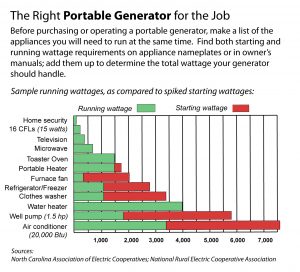
    If you’re part of the estimated 12 percent of Americans who own a portable generator, you know it can be valuable if the power goes out. But did you know generators can be dangerous to those working to restore power?portablegeneratorsamplewattages_nreca

    Our line crews take all of the necessary precautions before beginning work on downed power lines, but a generator connected to a home’s wiring or plugged into a regular household outlet can cause backfeeding (electricity flowing back into the power lines and grid) along power lines and electrocute anyone who comes in contact with them—even if the line appears dead.

    CAEC employees and other line workers are not the only ones in danger when a portable generator is used improperly. Generator owners themselves may be at risk of electrocution, fire injury, property damage or carbon monoxide poisoning if safety guidelines such as these are not followed:

    • Never connect a generator directly to your home’s wiring unless the home has been wired for generator use. This can cause backfeeding along power lines and electrocute anyone coming in contact with the generator. Have a licensed electrician install the equipment necessary to safely connect emergency generators.
    • Always plug appliances directly into generators. Connecting the generator to a home’s circuits or wiring must be done by a qualified, licensed electrician who will install a transfer switch to prevent backfeeding.
    • Use heavy-duty, outdoor-rated extension cords free of cuts or tears and be sure that the plug has three prongs. Overloaded cords can cause fires or equipment damage.
    • Never overload a generator. A portable generator
      should only be used when necessary to power essential equipment or appliances. Look at the labels on lighting, appliances and equipment to determine the amount of power needed to operate the equipment.
    • Turn off all equipment powered by the generator before shutting it down.
    • Keep the generator dry on a dry surface under an open structure.
    • Never fuel a generator while it is operating.
    • Read and adhere to the manufacturer’s instructions for safe operation. Never cut corners when it comes to safety and always have a fully charged fire extinguisher nearby.

    We encourage you to protect the well-being and safety of your family during outages, and safeguard those who come to your aid during power restoration.

  • Electricity Theft: Not Worth the Risk

    Each year, utilities across the country cope with thieves—folks who deliberately tamper with their electric meter to steal power. Not only is this practice extremely dangerous, it’s a serious crime with hefty fines and possible jail time.

    We’ve seen people do some dangerous things—using knives, forks, magnets, jumper cables, and any number of other objects to get around paying for the power they use.  However, not only are these individuals stealing from their fellow co-op members, they’re also risking their lives and those of our workers.

    According to the Cooperative Research Network, a division of the National Rural Electric Cooperative Association, power delivered through a compromised meter can cause an electrical catastrophe. A short circuit could produce an arc flash bright enough to cause blindness and powerful enough to launch fragments of shrapnel-like, red-hot debris. Serious injury or death from electrocution, explosion or fire often results from meter tampering. Only trained Central Alabama Electric Cooperative (CAEC) personnel wearing protective clothing should work on meters.

    Electricity theft is not a victimless crime. Your not-for-profit co-op loses revenue and expends resources to investigate tampering. These costs are then passed on to the entire membership. National estimates vary, but The Washington Post cited revenue protection officials who claim between $1 billion and $10 billion worth of electricity is stolen from utilities annually.

    Everyone pays for lost power. While we continue to monitor for theft through technology and on site personel, please let us know if you suspect meter tampering.  Call us at 1-800-5445-5735 to report possible theft of service. All information can be given anonymously.


  • Talk to your children about electrical safety

    Children often do not understand the danger of electricity and electrical equipment. In their innocent and imaginative minds, what can be potentially dangerous may go unnoticed or even appear enticing and fun. Take an opportunity to point out overhead power lines and any other electrical equipment to children and explain what they are.

    Safe Electricity recommends teaching children to follow these rules:

    • Never climb trees near power lines. Even if the power lines are not touching the tree, they could touch when more weight is added to the branch.
    • Kites and model airplanes should be flown only during good weather conditions in large open areas, like an open park or a wide field. Keep kites away from overhead power lines or other electrical equipment, such as substations. If a kite gets stuck in a tree near power lines, do not climb up to get it. Electricity can travel down kite strings or wires. Contact your electric utility for assistance.
    • Never climb a utility pole or tower. The electricity carried through this equipment is high voltage and could kill you.
    • Don’t play on or around pad-mounted electrical equipment. These are often green metal “boxes” on cement pads and contain transformers.
    • Never go into an electric substation. Electric substations contain high-voltage equipment; even raising your hand inside one can cause an arc that may cause an electric shock. Never attempt to retrieve a pet, ball, or any toy from these areas. Call your electric utility instead.
    • Immediately seek shelter if lightning or thunder is present while playing outdoors.
    • When designing a tree house or outdoor play area for children, take preventive precautions before starting your project. Do not install playground equipment or swimming pools underneath or near power lines. Installation of either will require digging; call your local underground utility locating service to have buried lines marked, so you can avoid serious injury and damage.

    Protect all family members from serious shock and injuries by installing ground fault circuit interrupters (GFCIs) on outdoor outlets and in interior rooms where water is present. A GFCI shuts off power instantly if it detects a problem. Use portable GFCIs for outdoor outlets that don’t have them. GFCIs are affordably priced and found at hardware stores.

    Be careful using electrical appliances outdoors, even if plugged into GFCI-equipped outlets. Never use appliances with frayed or damaged extension cords and always be sure the ground prong is intact.

    Teach kids never touch an electric appliance while in a pool or hot tub, to keep all electrical appliances at least ten feet away from pools, ponds, and wet surfaces, and that it is never safe to swim in a pool or lake when a storm is brewing.

    Teach older children to exercise caution before plugging in a radio, CD player, or any electrical gadget outdoors and never leave any electrical appliance outside. If it rains, the device could get wet and cause an electrical shock when used later.

    Flooded areas are never safe spots to wade or play in, and if there has been severe weather, may be in contact with energized electrical equipment or fallen power lines left behind.

    Make sure your family members know to stay away from downed power lines and wires and tell children to report any fallen or dangling wires to an adult. Downed power lines are dangerous; always assume any power line is energized and stay far away. Call your local utility immediately if you or your child encounters a downed power line and include this number with other posted emergency phone numbers.